The Thor Equities Data Center in Urbana, Ohio: Background and Timeline
Updated November 4, 2026, with the Nov. 3 election results (data center ban passes with 77%; Mayor Bean recalled with 73%, Eugene Fields Jr. to replace him), the Nov. 3 council meeting, where council took no action on the settlement and found its Oct. 20 tabling vote was invalid, and the federal docket listing Highland55 Investments as a Thor co-plaintiff. Earlier update (October 30) added the county’s Oct. 28 lawsuit over its 94-acre land sale in the project area (separate timeline). Earlier update (October 29) added an Oct. 20 Ohio Supreme Court ruling on a Lordstown data center moratorium and Urbana Daily Citizen coverage through Oct. 28: the ballot-wording confusion over the charter amendment, the Rittal expansion next to the site, and details of the Nov. 3 council meeting. Earlier update (October 22) added the October 20 council vote to table the settlement, a parcel map and deed dates from county records, and a correction to the site purchase date. Earlier update (October 11) added the proposed settlement, the October 6 council meeting, and earlier events reported by the Urbana Daily Citizen.
Related: Holes in the Proposed Thor Equities Settlement · Champaign County Sues Over the 94-Acre Land Deal
Introduction
In February 2026, Urbana residents learned that New York–based real estate firm Thor Equities planned to build a roughly 460,000-square-foot data center, branded the Urbana Technology Hub, on land near the intersection of State Route 55 and U.S. Route 68, south of the Rittal plant. Thor described about $1 billion in private investment. Texas-based operator CyrusOne later joined the project as an operations partner. The end user has never been disclosed.
The proposal surprised many residents. The groundwork had been laid more than a year earlier. In April 2025, city council added data centers as a permitted use in the M-1 manufacturing district and annexed and rezoned Thor’s property. In November 2025, council approved a Community Reinvestment Area tax abatement for the project. Most residents say they had no idea a data center was coming until the plan was read aloud at a February 2026 council meeting.
Opposition organized quickly around three concerns:
- Cedar Bog. The rare, groundwater-fed fen lies about one and a half to two miles southwest of the site. The Cedar Bog Association warned that a data center could threaten the groundwater the preserve depends on.
- Proximity. Urbana Middle School, a senior living center, and residential development all sit near the site.
- Utilities and transparency. Residents worried about water use, power rates, and noise. They also questioned how long city officials had worked with the developer without public discussion.
Thor and city officials argued the project would bring about $3 million a year in city tax revenue and about $2.8 million a year for Urbana City Schools, and that it would use closed-loop cooling and not raise local utility rates.
Over the following months the city reversed course. It passed a moratorium, repealed the zoning that permitted data centers, and drew a federal lawsuit from Thor. The dispute spread into a November ballot measure to ban data centers and a recall election against the mayor. In late September, court-ordered mediation produced a proposed settlement. Its terms, made public in early October, would allow up to 2 million square feet of data center space, more than four times the original proposal, in exchange for up to $50 million in payments to the city. On October 20, council voted 4–3 to table it. On November 3, Urbana voters approved the charter amendment banning data centers, 77% to 23%, and recalled Mayor Bill Bean, 73% to 27%. The same night, council took no action on the settlement and found that its October 20 tabling vote had fallen short of the five votes its rules require. The settlement is expected back on November 17. Election officials say the ban applies only to future data centers, so Thor’s project now turns on the federal lawsuit and the state appeal.
Site Map
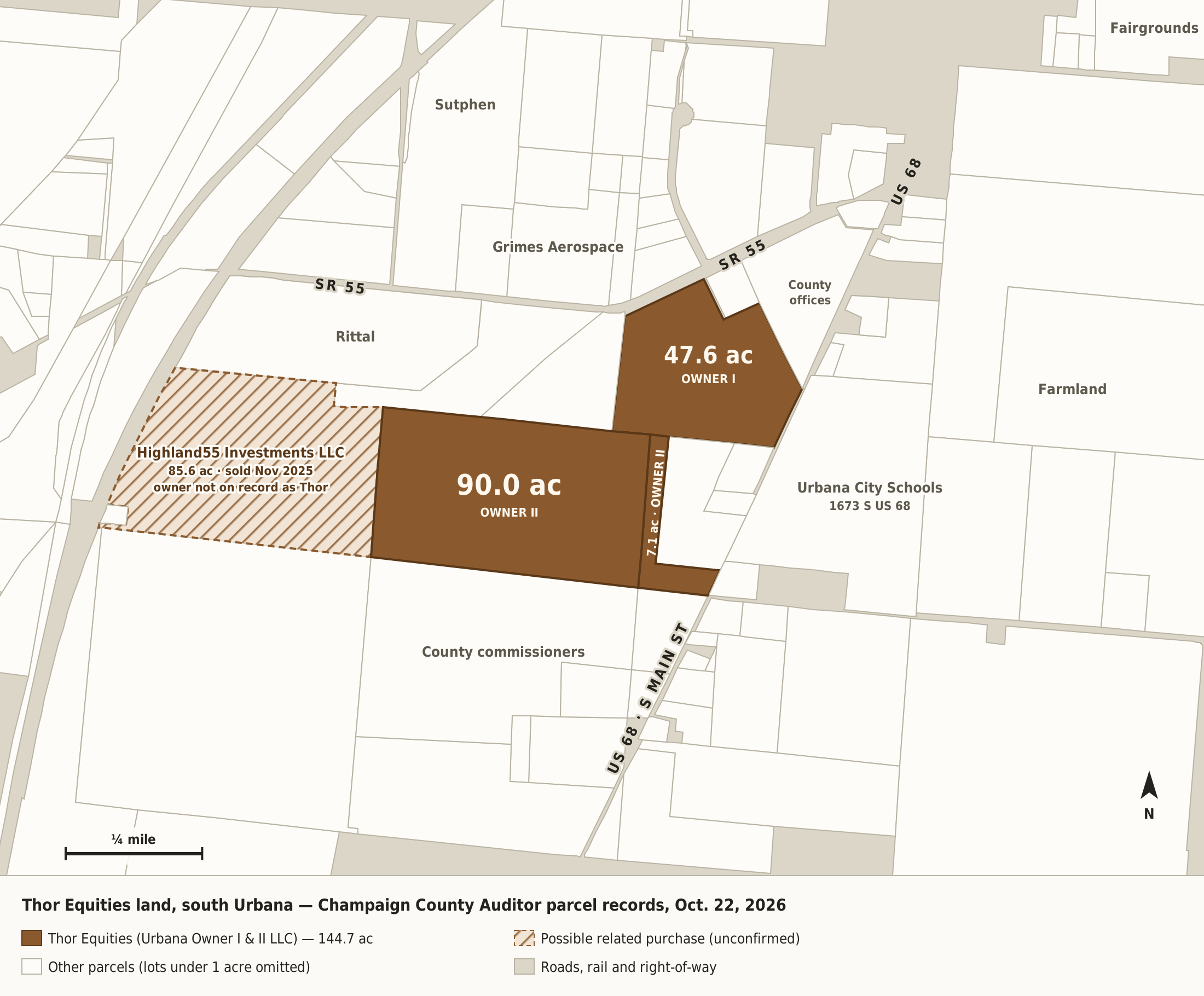
The Champaign County Auditor’s parcel records show three parcels, 144.7 acres in all, held by two Thor Equities LLCs. All three are mailed to Thor Equities at 25 W 39th St, New York. Together they run from SR 55 south and east to US 68, beside the Urbana City Schools parcel at 1673 S US 68.
| Parcel | Owner of record | Acres | Recorded sale | Price |
|---|---|---|---|---|
| K48-25-11-01-30-001-00 | Urbana Owner I LLC (taxpayer: Thor Equities LLC) | 47.637 | Aug. 22, 2025 | $2,143,665 |
| K48-25-11-01-30-006-00 | Urbana Owner II LLC (c/o Thor Equities) | 90.000 | June 12, 2026 | $3,398,150 (one sale, both parcels) |
| K48-25-11-01-30-005-00 | Urbana Owner II LLC (c/o Thor Equities) | 7.090 | June 12, 2026 | |
| Total | 144.727 | $5,541,815 |
The two Owner II parcels match the “nearly 100 acres of Organ Farms land (about $3.4 million)” in the timeline below.
The hatched parcel to the west is 85.6 acres owned by Highland55 Investments LLC of Columbus, sold in November 2025 for $3,210,713. The county record does not name Thor. Its size is the reason it is shown. It plus the 47.6-acre parcel make about 133 acres, the figure reported for Thor’s 2025 purchases. All four parcels together total about 230 acres, the figure Thor gave in its federal lawsuit. The federal docket lists Highland55 Investments LLC as a co-plaintiff with Thor Equities and the Urbana Owner LLCs, so the parcel is part of Thor’s claim even though the county record does not name Thor as owner.
The blue hatched land directly south of Thor’s 90 acres belongs to the Champaign County Commissioners: parcels K48-25-11-01-36-001-00 (85.3 acres) and K48-25-11-01-37-001-00 (9.2 acres), 94.5 acres in all. This appears to be the 94.11 acres the county agreed in September 2024 to sell to Urbana0624C LLC for $3,293,850. The county sued the buyer on Oct. 28, 2026, saying it defaulted and the sale is off (see the county land lawsuit timeline). The parcels run from Thor’s southern line east to US 68. The county’s acreage of record is slightly larger than the contract figure.
Boundaries come from the county auditor’s parcel layer as of Oct. 22, 2026 (county parcels checked Oct. 30). Lots under one acre are omitted from the drawing.
Timeline
| Date | Event |
|---|---|
| ~2024 | WDTN reports the site was secured about a year and a half before the February 2026 announcement. No sale was recorded then. The first deed to a Thor entity was recorded Aug. 22, 2025, so the 2024 date likely reflects a purchase agreement rather than a closing. |
| April 2025 | City council amends zoning to allow data processing and computing infrastructure as a permitted use in M-1 districts (Ordinance 4621-25). At the same meeting, it annexes Thor’s property and rezones it M-1. |
| Aug. 22, 2025 | Urbana Owner I LLC, whose tax bills go to Thor Equities, records its purchase of 47.6 acres at SR 55 and US 68 from Brand Investments Ltd. for $2,143,665 ($45,000 an acre). |
| Nov. 18, 2025 | Highland55 Investments LLC of Columbus buys the adjoining 85.6 acres from Brand Investments for $3,210,713 ($37,500 an acre). WDTN later reports that Thor bought two parcels totaling 133 acres in the second half of 2025, which matches these two sales, but the county record does not name Thor as owner of this parcel. |
| November 2025 | Council approves a Community Reinvestment Area agreement with Thor, creating a tax abatement for the project. |
| February 2026 | Thor submits a site plan application. The city deems it incomplete. |
| Feb. 17, 2026 | City staff read Thor’s project description aloud at council. An emergency moratorium on the agenda is withdrawn by a 5–2 vote. Public comment is overwhelmingly opposed. |
| Feb. 20, 2026 | An online petition to stop the data center launches. It passes 3,600 signatures within days and nears 8,000 by early March. |
| Feb. 23, 2026 | The Cedar Bog Association urges supporters to attend the Planning Commission meeting and contact council members. |
| March 3, 2026 | Before an overflow crowd at the Champaign County Community Center, council passes a 12-month moratorium on new data centers, 6–1 (Resolution 2727-26). It runs to March 2027. |
| April 2026 | The Board of Zoning Appeals rules against Thor’s application. Council creates the Data Center Moratorium Committee, co-chaired by Bryce Carafa and Joe Buckalew, to study impacts and recommend regulations. Thor launches a public website for the project. |
| April 22, 2026 | Council votes unanimously to begin repealing the ordinance that permits data centers on industrial land. |
| May 4, 2026 | Council formally starts the zoning rollback by resolution and sends it to the Planning Commission. |
| May 2026 | Thor files an administrative appeal of the BZA decision in Champaign County Common Pleas Court. Members of a citizen coalition later intervene in that case. |
| May 18, 2026 | The Planning Commission votes unanimously to recommend that council reverse the zoning. |
| June 5, 2026 | Thor exercises a purchase agreement for nearly 100 acres of Organ Farms land (about $3.4 million), a possible southern access point from US 68. The deed to Urbana Owner II LLC is recorded June 12: two parcels, 97.1 acres, $3,398,150. |
| June 16, 2026 | Council unanimously repeals Ordinance 4621-25, removing data centers as a permitted use in the M-1 district. |
| June 19, 2026 | Thor files a federal lawsuit against the city, council, and BZA: Thor Equities, LLC et al. v. City of Urbana, No. 3:26-cv-00196 (S.D. Ohio). Thor says it spent $19.6 million and assembled about 230 acres, and claims vested rights to build. |
| July 7, 2026 | Law Director Mark Feinstein resigns, effective Aug. 7. Matthew Watson later serves as interim law director. The same day, residents launch two petitions: Nicole Nawman’s charter amendment to ban data centers, and James Cropper’s recall of Mayor Bill Bean. |
| July 17, 2026 | The Board of Elections certifies the recall petition for the Nov. 3 ballot. |
| July 20, 2026 | In Thor’s Common Pleas appeal, the court finds the record incomplete and orders a full transcript of the April 13 BZA hearing added at Thor’s expense. It sets a briefing schedule: Thor’s brief by Sept. 2, the city’s response by Oct. 2, and Thor’s reply later in October. |
| July 27, 2026 | Mayor Bean issues a public statement calling the recall allegations “false” and “distorted.” |
| Aug. 4–5, 2026 | Council approves placing the charter amendment on the ballot; a typographical error sends it to the Ohio Secretary of State for review. Candidates file to replace Bean if he is recalled. |
| Aug. 31, 2026 | The Secretary of State clears the charter amendment for the ballot. It would ban data center construction in the city outright, exempting only a single company’s in-house facility drawing less than 7.5 megawatts. |
| September 2026 | A citizen coalition (the “Urbana Coalition”) moves to intervene in the federal case, arguing Thor has no vested rights. The motion is put on hold during mediation. |
| Sept. 21 and 25, 2026 | Court-ordered mediation sessions are held between the city and Thor. |
| Sept. 29, 2026 | The city announces that mediation produced a proposal from Thor for council to consider. No details are released. |
| Oct. 4, 2026 | Mayor Bean issues an open letter summarizing the proposed settlement and calling it “a good deal.” Terms include Thor releasing claims it values at over $115 million, payments to the city of up to $50 million, no CRA tax abatement, and a Thor-funded environmental study. |
| Oct. 6, 2026 | Early voting begins. The Moratorium Committee co-chairs ask council to table any vote until their written findings are delivered in early 2027. At a meeting of about four and a half hours, roughly 30 residents speak, most against the deal. Council receives the MOU in executive session for more than an hour but takes no action, though the MOU called for approval by Oct. 7. |
| Oct. 7–8, 2026 | Opponents obtain the MOU text. It allows up to 2 million net interior square feet in phases, with generators, substations, and cooling equipment excluded from that total. Payments would be $5 million at the Phase One building permit, then $20 million, $15 million, and $10 million at certificates of occupancy for Phases One through Three. |
| Oct. 12, 2026 | The Urbana Daily Citizen reprints a Sidney Daily News story on Grid Growth Ventures’ proposed 765-kilovolt transmission line, noting it is the same project proposed for Champaign County. Construction is planned to begin in 2027 on lines carrying power from Indiana to Ohio substations serving data centers, factories, and homes. |
| Oct. 20, 2026 | In a case from Lordstown, the Ohio Supreme Court rules unanimously that a village need not finish reviewing a data center site plan submitted before its moratorium took effect. A developer’s rights do not vest when it files, the court holds, unless it has already met every requirement, including completed site-plan review. The ruling, State ex rel. Bristolville 25 Developer LLC v. Lordstown, 2026-Ohio-4073, bears directly on Thor’s vested-rights argument over its incomplete February application. |
| Oct. 20, 2026 | After about 90 minutes in executive session, council votes 4–3 to table the settlement. Stephanie Truelove, Cledis Scott, Patrick Thackery, and Amy Jumper vote to table. Residents hold “No Deal” signs, and the Moratorium Committee again asks for time, saying its findings point to a substantial health burden from pollution. Thor global COO Melissa Gliatta tells council the company has invested about $19.6 million. WDTN headlines the vote as council choosing to fight the lawsuit. |
| Oct. 26, 2026 | The Urbana Daily Citizen reports that some voters may be voting against their own intent on the charter amendment. Because of the “No Data Center” yard signs and the “No Deal” campaign, many believe a “No” vote bans data centers. Petition organizer Nicole Nawman says a “Yes” vote is needed to approve the ban. |
| Oct. 26, 2026 | The Ohio Tax Credit Authority approves a nine-year Job Creation Tax Credit for Rittal LLC on SR 55, directly north of the Thor site. Rittal, which makes IT infrastructure components for data centers, expects to add 182 full-time jobs and about $12 million in annual payroll in Urbana by the end of 2029. |
| Oct. 28, 2026 | The Champaign County Commissioners sue Urbana0624C LLC and Talon Title Agency LLC in Common Pleas Court over a 2024 agreement to buy 94.11 county-owned acres in the project area for $3,293,850. The county says the buyer defaulted by not closing in early 2026 and asks the court to end its obligation to sell and award it $30,000 in deposits. See the county land lawsuit timeline. |
| Nov. 3, 2026 | Election. Final, unofficial results from the Champaign County Board of Elections: the charter amendment banning data centers passes, 2,978 to 877 (77.25%). The recall of Mayor Bill Bean passes, 2,707 to 985 (73.32%). Eugene E. Fields Jr., a Republican and former longtime council member and the only replacement candidate on the ballot, receives 2,184 votes and will become mayor. Board director Meredith Anderson says the amendment applies only to future data centers, leaving the courts as the only obstacle to Thor’s project. City administration director Spencer Mitchell says the city will review with its attorneys how the amendment affects the proposed settlement. Bean did not respond to requests for comment on election night. |
| Nov. 3, 2026 | Council meeting. Council neither votes on the settlement nor tables it. It finds that tabling requires a two-thirds majority (five votes) under its rules, so the Oct. 20 vote of 4–3 never tabled the resolution. The resolution, listed as a second reading, must now go through three readings. In other business, council gives first reading to an ordinance authorizing up to $3.1 million in bonds for new fire trucks. |
| Nov. 17, 2026 | (Scheduled) Council’s next regular meeting. The settlement is expected back on the agenda. Council could instead table it to the first meeting in December. |
| Nov. 19, 2026 | (Scheduled) The Board of Elections certifies the results. Fields becomes mayor on certification and can be sworn in that day. He will serve the rest of Bean’s term, through Dec. 31, 2027. |
Open Questions
- Effect of the ban on Thor. The Board of Elections says the charter amendment applies only to future data centers. Whether Thor’s project counts as “future” depends on its vested-rights claim, which is before both the federal court and the Common Pleas court. The city says it is reviewing with its attorneys how the ban affects the settlement.
- Settlement vote. Because the Oct. 20 tabling was invalid, the settlement needs three readings. It is expected back on Nov. 17. Can council approve a settlement allowing up to 2 million square feet of data center space after voters wrote a ban into the charter? And would the new mayor sign it?
- New mayor. Fields takes office about Nov. 19. He has been an outspoken opponent of the data center. How the change at City Hall affects the city’s position in the litigation and the settlement is not yet known.
- Project size. The MOU allows up to 2 million square feet, more than four times the 460,000 square feet originally described, with power, cooling, and generator equipment excluded from that limit.
- Lawsuits. As of Nov. 4, there is no reported ruling in the federal case or the Common Pleas appeal. The Ohio Supreme Court’s Oct. 20 Lordstown ruling weakens a state-law vested-rights claim based on an incomplete application, but Thor’s federal suit also raises constitutional claims that the ruling does not decide. The citizen coalition’s motion to intervene in the federal case is pending.
- Land ownership. County records show 144.7 acres in Thor-named LLCs. Highland55 Investments, owner of the adjoining 85.6 acres, is a co-plaintiff in Thor’s federal suit, which accounts for the roughly 230 acres Thor cites.
Sources
- Champaign County Auditor, parcel records for K48-25-11-01-30-001-00, -005-00, -006-00 and K48-25-11-01-32-005-00 (accessed Oct. 22, 2026) — https://auditor.co.champaign.oh.us/Parcel?Parcel=K48-25-11-01-30-001-00
- Urbana Daily Citizen, “Feinstein steps down as city law director” (July 7, 2026) — https://www.urbanacitizen.com/2026/07/07/feinstein-steps-down-as-city-law-director/
- Urbana Daily Citizen, “Mayoral recall, charter amendment on Nov. ballot” (July 20, 2026) — https://www.urbanacitizen.com/2026/07/20/mayoral-recall-charter-amendment-on-nov-ballot/
- Urbana Daily Citizen, “Mayor Bean issues public statement” (July 27, 2026) — https://www.urbanacitizen.com/2026/07/27/mayor-bean-issues-public-statement/
- Urbana Daily Citizen, “Candidates file to replace Mayor Bean” (Aug. 7, 2026) — https://www.urbanacitizen.com/2026/08/07/candidates-file-to-replace-mayor-bean/
- Urbana Daily Citizen, “Data center ban will be on Urbana ballot” (Aug. 31, 2026) — https://www.urbanacitizen.com/2026/08/31/data-center-ban-will-be-on-urbana-ballot/
- Urbana Daily Citizen, “City council to vote on Thor proposal” (Sept. 30, 2026) — https://www.urbanacitizen.com/2026/09/30/city-council-to-vote-on-thor-proposal/
- Urbana Daily Citizen, “Coalition against data center urges citizens to attend Oct. 6 meeting” (Oct. 6, 2026) — https://www.urbanacitizen.com/2026/10/06/coalition-against-data-center-urges-citizens-to-attend-oct-6-meeting/
- Urbana Daily Citizen, “Council delays vote on Thor settlement” (Oct. 7, 2026) — https://www.urbanacitizen.com/2026/10/07/council-delays-vote-on-thor-settlement/
- Urbana Daily Citizen, “Data Center Moratorium Committee asks council to await its findings before settlement vote” (Oct. 8, 2026) — https://www.urbanacitizen.com/2026/10/08/data-center-moratorium-committee-asks-council-to-await-its-findings-before-settlement-vote/
- Urbana Daily Citizen, “Opposition wants ‘No deal’ on proposed data center settlement” (Oct. 8, 2026) — https://www.urbanacitizen.com/2026/10/08/opposition-wants-no-deal-on-proposed-data-center-settlement/
- Urbana Daily Citizen, “Transmission lines threaten growth in Shelby Co.” (Oct. 12, 2026) — https://www.urbanacitizen.com/2026/10/12/transmission-lines-threaten-growth-in-shelby-co/
- Urbana Daily Citizen, “City council tables Thor MOU” (Oct. 21, 2026) — https://www.urbanacitizen.com/2026/10/21/city-council-tables-thor-mou/
- Peak of Ohio, “Court grants Thor Equities’ request in Urbana data center case” (July 20, 2026) — https://www.peakofohio.com/featured-news/court-grants-thor-equities-request-in-urbana-data-center-case/
- Peak of Ohio, “Urbana City Council tables decision on data center settlement” (Oct. 21, 2026) — https://www.peakofohio.com/local-news/urbana-city-council-tables-decision-on-data-center-settlement/
- Court News Ohio, “Village Can Reject Data Center Construction Application After Moratorium Imposed” (Oct. 20, 2026), summarizing State ex rel. Bristolville 25 Developer LLC v. Lordstown, Slip Opinion No. 2026-Ohio-4073 — https://www.courtnewsohio.gov/cases/2026/SCO/1020/251497.asp
- Dayton 24/7 Now, “Urbana council postpones decision on $1B data center settlement vs. legal fight” (Oct. 21, 2026) — https://dayton247now.com/news/local/urbana-council-postpones-decision-on-1b-data-center-settlement-vs-legal-fight
- Springfield News-Sun, “Urbana council takes no action on proposed data center settlement” (Oct. 7, 2026) — https://www.springfieldnewssun.com/local/urbana-council-takes-no-action-on-proposed-data-center-settlement/article_a7d516c4-7a31-5d7f-9127-cdd89c13d9bd.html
- WDTN, “Urbana City Council votes to fight data center lawsuit” (Oct. 21, 2026) — https://www.wdtn.com/news/miami-valley-data-centers/urbana-city-council-votes-to-fight-data-center-lawsuit/
- Urbana Daily Citizen, “Anti-data center issue requires ‘Yes’ for passage” (Oct. 26, 2026) — https://www.urbanacitizen.com/2026/10/26/anti-data-center-issue-requires-yes-for-passage/
- Urbana Daily Citizen, “Land in proposed data center area part of civil case” (Oct. 29, 2026) — https://www.urbanacitizen.com/2026/10/29/land-in-proposed-data-center-area-part-of-civil-case/
- Urbana Daily Citizen, “Rittal set to expand in Urbana” (Oct. 26, 2026) — https://www.urbanacitizen.com/2026/10/26/rittal-set-to-expand-in-urbana/
- Peak of Ohio, ““We cannot be bought”: Urbana residents challenge data center deal” (Oct. 7, 2026) — https://www.peakofohio.com/local-news/we-cannot-be-bought-urbana-residents-challenge-data-center-deal/
- Springfield News-Sun, “Urbana council tables data center settlement proposal for second time” — https://www.springfieldnewssun.com/local/urbana-council-tables-data-center-settlement-proposal-for-second-time/article_79d7634c-e12e-5aa4-9731-81436857bfd5.html
- WYSO, “Urbana passes moratorium on new data centers, leaving $1B proposal in limbo” (March 4, 2026) — https://www.wvxu.org/2026-03-04/urbana-passes-moratorium-on-new-data-centers-leaving-1b-proposal-in-limbo
- WYSO, “Urbana begins walking back zoning changes that permitted data centers” (May 14, 2026) — https://www.wyso.org/news/2026-05-14/urbana-begins-walking-back-zoning-changes-that-permitted-data-centers
- WYSO, “Urbana backed down from rules paving way for big data centers. Now a developer is suing” (June 23, 2026) — https://www.wyso.org/environment-news/2026-06-23/urbana-backed-down-from-rules-paving-way-for-big-data-centers-now-a-developer-is-suing
- WYSO, “Two Urbana residents start petitions in response to data center dispute” (July 15, 2026) — https://www.wyso.org/news/2026-07-15/two-urbana-residents-start-petitions-in-response-to-data-center-dispute
- WDTN, “Urbana debates $1B data center project despite opposition” — https://www.wdtn.com/news/local-news/urbana-debates-1b-data-center-project-despite-opposition/amp/
- WDTN, “Urbana data center proposal sparks backlash from residents” — https://digital-release.wdtn.com/news/local-news/urbana-data-center-proposal-sparks-backlash-from-residents/
- WDTN, “Urbana City Council pauses data center project” — https://digital-release.wdtn.com/as-seen-on-2-news/urbana-data-center-city-council-meeting-march-3/amp/
- WDTN, “Urbana data center plans face reversal after critical vote” — https://www.wdtn.com/news/miami-valley-data-centers/urbana-data-center-plans-face-reversal-after-critical-vote/amp/
- WDTN, “Data center developers secure farmland near Urbana site” — https://www.wdtn.com/news/local-news/data-center-developers-secure-farmland-near-urbana-site/amp/
- WDTN, “Thor Equities files lawsuit against Urbana after data center moratorium” — https://www.wdtn.com/news/miami-valley-data-centers/thor-equities-files-lawsuit-against-urbana-after-data-center-moratorium/amp/
- DataCenterDynamics, “Thor Equities files lawsuit against Ohio’s Urbana after data center moratorium disrupts project” — https://www.datacenterdynamics.com/en/news/thor-equities-files-lawsuit-against-ohios-urbana-after-data-center-moratorium-disrupts-project/
- Cedar Bog Association, “Urgent Request on Opposition to Data Center in Urbana, OH” — https://www.cedarbognp.org/urgent-request-on-opposition-to-data-center-in-urbana-oh/
- States Newsroom, “Data centers are on the November ballot in these 18 Ohio communities” (Sept. 14, 2026) — https://www.newsfromthestates.com/node/427338
- Peak of Ohio, “Bean out as Mayor, data centers banned in Urbana; 2026 midterm election results” (Nov. 4, 2026) — https://www.peakofohio.com/local-news/bean-out-as-mayor-data-centers-banned-in-urbana-2026-midterm-election-results/
- Peak of Ohio, “Urbana Council takes no action on Thor agreement” (Nov. 4, 2026) — https://www.peakofohio.com/local-news/46917/
- Springfield News-Sun, “Urbana data center ban, mayor recall pass in final, unofficial results” (Nov. 3–4, 2026) — https://www.springfieldnewssun.com/local/urbana-data-center-ban-mayor-recall-pass-in-final-unofficial-results/article_9e06e857-7744-5b4f-b813-191707d2c226.html
- Springfield News-Sun, “Urbana data center: What happens if the charter amendment and proposed settlement pass?” — https://www.springfieldnewssun.com/local/urbana-data-center-what-happens-if-the-charter-amendment-and-proposed-settlement-pass/article_3820c658-ed1b-5510-9a30-2106f5413689.html
- WHIO, “Election 2026: Voters decide to ban data centers, recall Urbana mayor” (Nov. 4, 2026) — https://www.whio.com/news/local/election-2026-voters-decide-ban-data-centers-recall-urbana-mayor/BDVOCXCRMJHZPCPYXE43A5RJCQ/
- WYSO, “Latest 2026 election results for the Miami Valley” (Nov. 3, 2026) — https://www.wyso.org/government-politics-news/2026-11-03/latest-2026-election-results-for-miami-valley
- CourtListener, docket for Thor Equities, LLC v. City of Urbana, Ohio, No. 3:26-cv-00196 (S.D. Ohio) — https://www.courtlistener.com/docket/73509496/thor-equities-llc-v-city-of-urbana-ohio/