Pinpointing with the Garrett ACE 400 and Its DD Coil
Pinpointing is mostly muscle memory. This guide covers general technique, the specifics of the ACE 400’s stock DD coil, and a practice plan to build accuracy.
How the DD coil “sees”
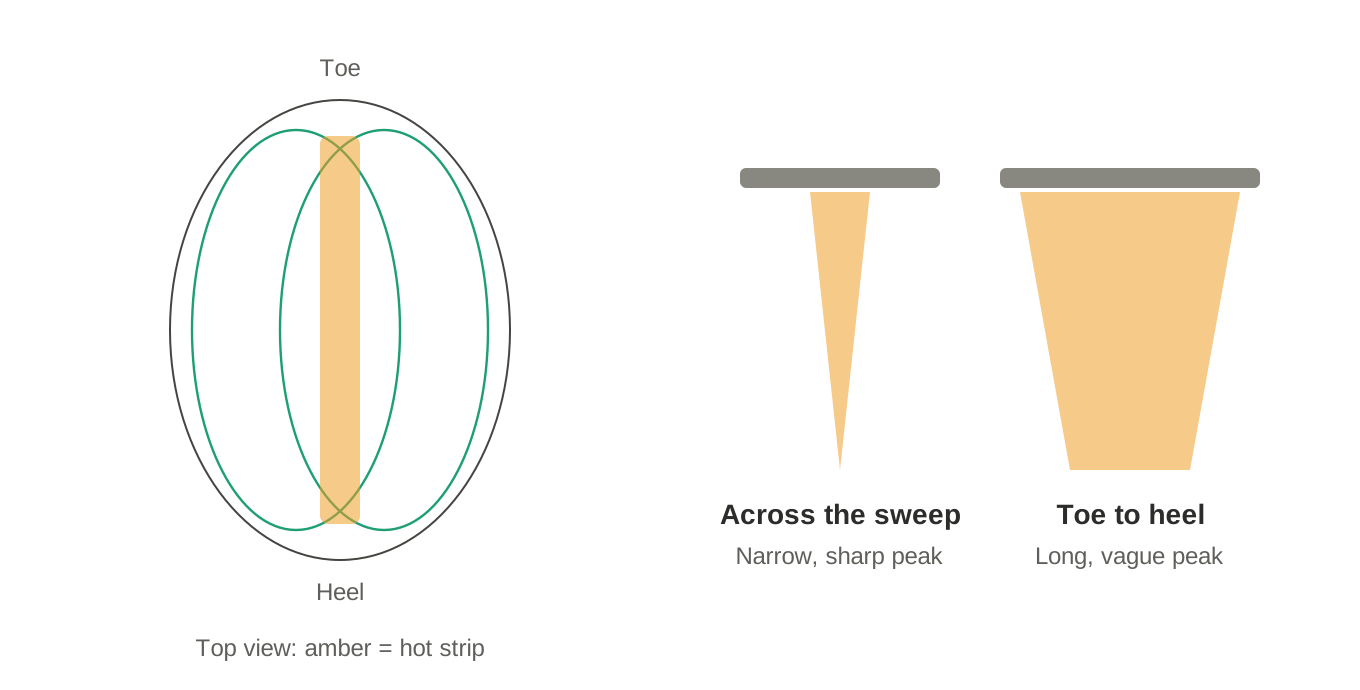
The ACE 400’s stock 7”×10” PROformance coil is a Double-D (DD) design. Two D-shaped windings, one transmit and one receive, sit back to back with an overlap. The overlap produces an elliptical sensing zone that runs toe to heel and gives a chisel-shaped signal that covers ground evenly.
- Across the sweep (left-right): the field is a narrow wedge. The peak is sharp, so left-right pinpointing is accurate.
- Toe to heel (front-back): the field is a long chisel. The peak is vague, so front-back location is less precise.
- Once centered, the target is usually under the middle of the coil, roughly below the shaft mount. Verify this in your own test garden.
DD coil pros and cons
| Detail | |
|---|---|
| Harder pinpointing | DD coils need a deliberate technique, and larger DD coils are harder to pinpoint. A smaller DD (about 5×8”) pinpoints much tighter than the stock 7×10. |
| Near obstacles | The elliptical housing puts the sensing area close to the edge, so you can hunt beside trees and fences if you sweep parallel to the obstacle. |
| Ground mineralization | A DD sees about 70% less ground mineral effect than concentric coils. It runs more stably in mineralized or shifting soil. |
| Coverage | Scans a wider path and needs less strict overlap. Overlap still matters at the depth limit, where the field narrows. |
| Frequency | Coil performance depends on operating frequency. The ACE 400 runs single-frequency at 10 kHz, which is good for coins and relics and weaker on tiny gold. |
Core technique: the X (crosshair)
- Sweep side to side until the tone peaks. Note the spot.
- Turn 90° and sweep across that spot. With a DD coil this matters most, because the second pass crosses the long strip the other way.
- Repeat with shorter, slower sweeps until the strongest signal is under one spot. Keep the coil flat and at a steady height the whole time.
ACE 400 pinpoint button
- Non-motion mode: hold the button and the coil can hover. The tone rises in pitch and volume as you get closer to the target.
- Start off to the side: press it with the coil to the side and a few inches up, then keep holding as you slide over the target. Pressing directly over the target cancels it out.
- Detune to narrow it: over a strong signal, release, then press again with the coil partly over the target. Repeat 1–2 times and the hot zone shrinks to a couple inches. This is the best trick for big or shallow targets.
- All-metal: pinpoint mode has no discrimination, so a nearby nail will pull the signal. If the pinpoint center doesn’t match where the discriminating sweep peaked, suspect iron next to the target.
- Depth reading: the display shows depth in 2” steps. It’s calibrated for a coin-sized target, so large objects read shallower than they are and tiny ones read deeper.
- Iron Audio: turn it on so iron gives a low grunt even when it’s notched out. This keeps you from passing over a coin that sits next to a nail.
Other techniques
- Wiggle: small 2–3” side-to-side motions over the spot sharpen the signal.
- Edge pinpointing: use the coil’s tip or tilt one side up for a narrower field.
- Lift test: raise the coil slowly. A small or deep target drops out fast, and a big shallow one keeps signaling.
Practice plan
| When | Drill | Goal |
|---|---|---|
| Week 1 | Air test. Lay a coin on a table and use pinpoint to find the coil’s true hot spot. Mark it on top of the coil with tape. | Know your sweet spot |
| Weeks 2–4 | Test garden. Bury a coin, nail, pull tab, ring, and bottle cap at 2”, 4”, 6”, and 8”, about 2 ft apart, and map them. Let the soil settle a few weeks. | Learn signals by depth |
| Weeks 2–4 | Blind drill. Have someone bury a coin. Pinpoint it, push in a golf tee at your center, dig, and measure your error. Log every attempt. | Error under 1” |
| Ongoing | Plug check. Check the plug and the hole separately before digging further. | Find any consistent bias |
| After that | Coin plus nail. Bury pairs 2–4” apart and practice separating them. | Handle trashy ground |
Common errors
- Coil height changing during the sweep, which shifts the peak
- Sweeping too fast near the target
- Pressing pinpoint directly over the target
- Assuming the DD hot spot is a point rather than a toe-to-heel strip
Gear
A handheld pinpointer finishes the job once the coil has you within a few inches. It roughly halves dig time and hole size. The Garrett Pro-Pointer AT pairs naturally with the ACE 400, and the Carrot is a budget option.
Further reading
- Double-D Search Coils – MetalDetectingWorld
- Target Pinpointing Techniques – MetalDetectingWorld
- Related pages on the same site: pinpointing angled coins, coins on edge, and coins near trash